
Dear Water Jug,

When I was eight our family of six piled into our astro mini van and headed east. Like so many family vacations as a child, I didn’t know where we were going or why, I just knew to get in the van and not to forget the water jug–a red, Tupperware jug that held four liters for the whole family to share. Do I even need to mention that we packed our own ham sandwiches or is that a given?

At some point between the alphabet game and the ham sandwich lunch break, I learned my Dad had a cousin who lived in Washington D.C. and we were heading down I-75 for a week of American history. This is most likely the moment when the word vacation became synonymous with visiting historical battle sites or the Amish.

Cousin Linda had been a government employee of some kind, which in my mind meant you wore shiny pants to work and knew the pledge of allegiance by heart. By the time I met her, she had retired her shiny pants and grew blueberries in the backyard with her husband and had a jukebox in the basement. The best feature of the house was a matching salt and pepper shaker set that played Glen Miller’s In the Mood and danced when you twisted them, like tiny, robotic cabaret singers. As soon as their song was finished, I would crank them again and my sister and I would watch the plastic dancers, mesmerized.
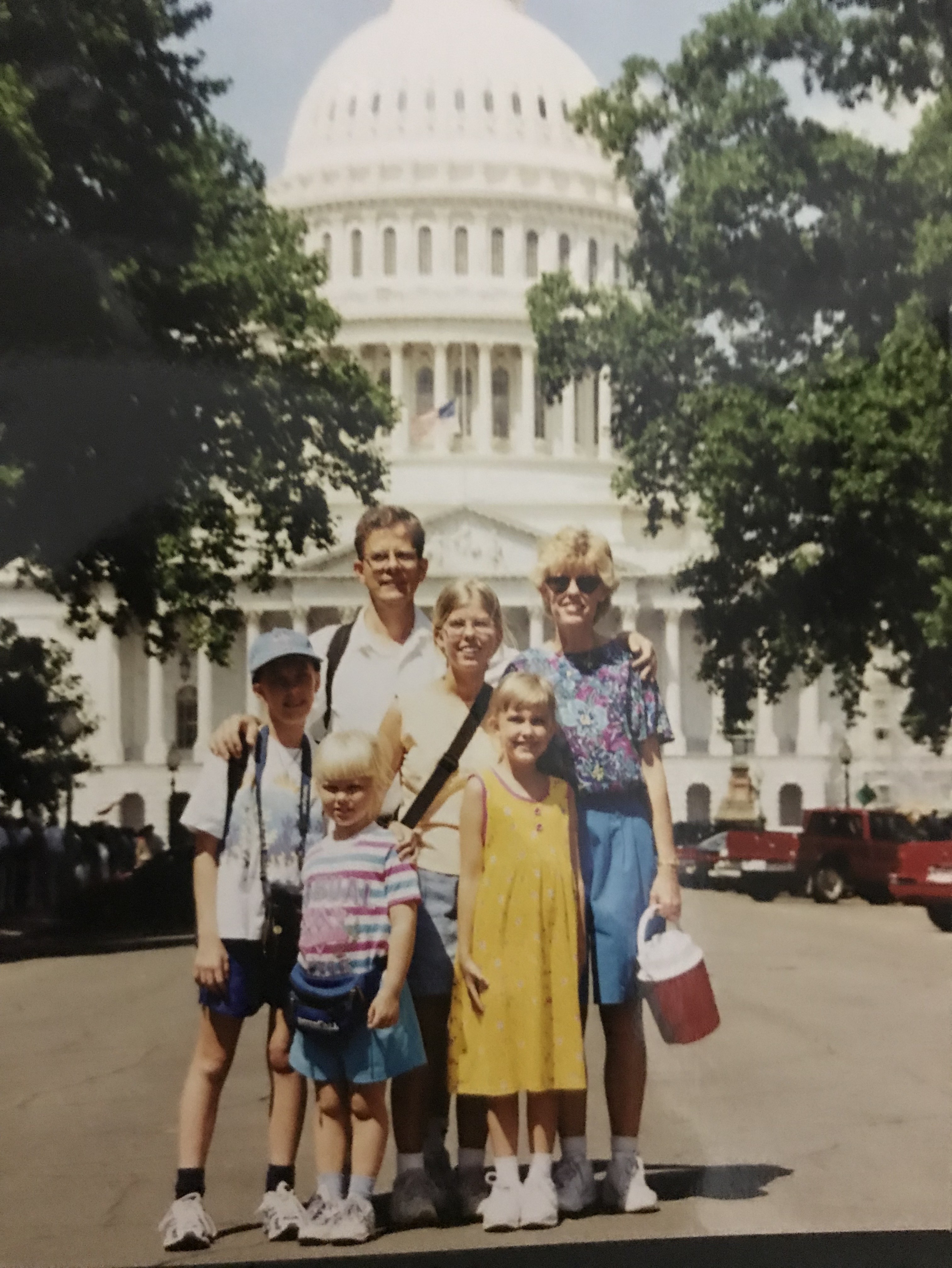
I’m the one in the fanny-pack; Another one of my friends on this trip.

We had traipsed through a weeks worth of every free institution our nation’s capitol had to offer. In every portrait gallery, memorial, library, even a tour of the White House, like an albatross around my neck, the water jug was there too. Having not yet exhausted their appetites for nuanced American history, my parents took us to Newseum–a museum dedicated to the first amendment and the history of journalism. It had a podium with the presidential seal where visitors could pose for pictures.

My parents truly loved each of us equally, would give limbs and kidneys for our well being, but really only saw presidential potential in one of us. “Julie, pretend you’re giving your inaugural address!”
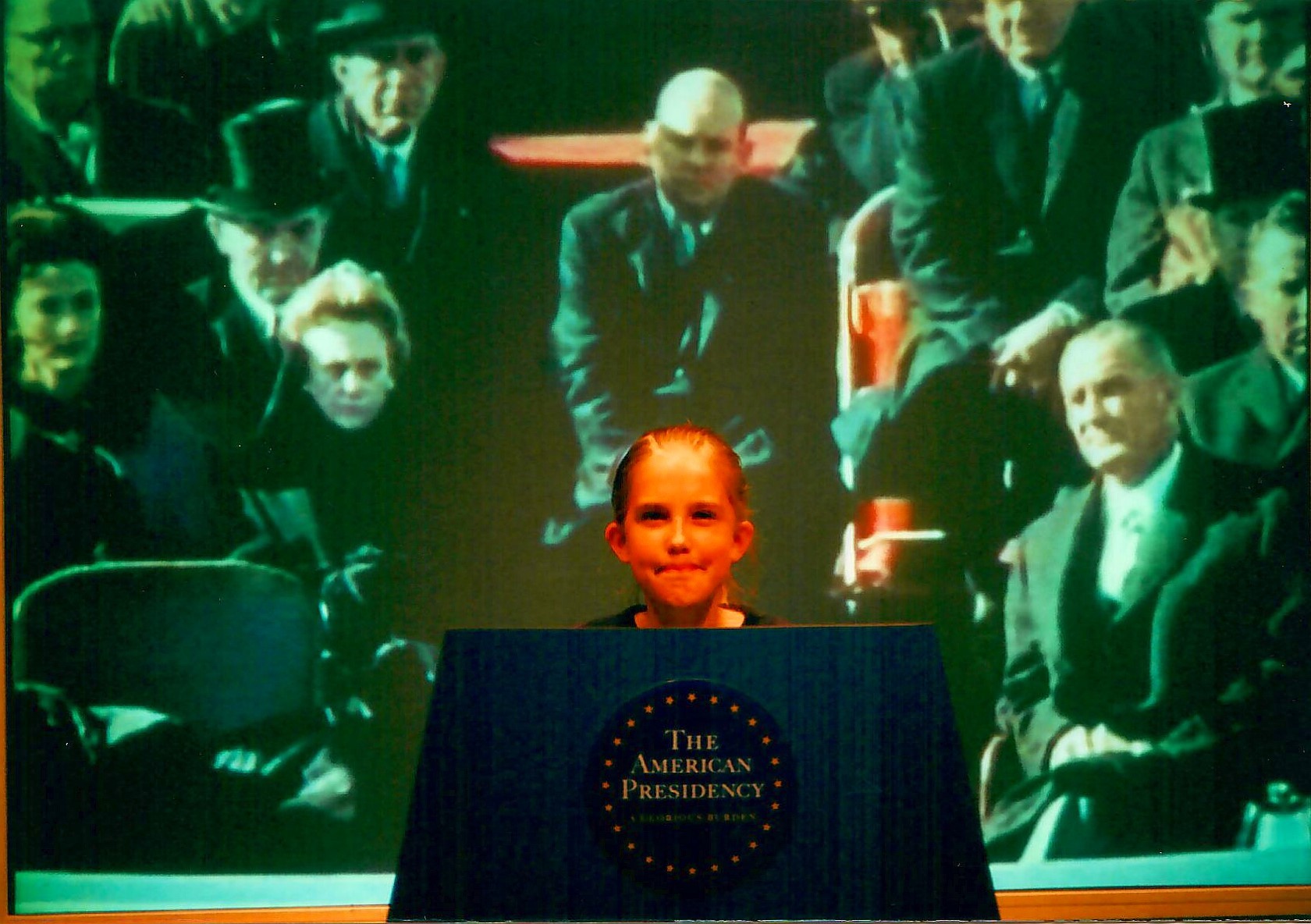
I lingered by the podium, hoping to be noticed. I held the red water jug at my side like a brief case, practically screaming, “I have professional potential!” Seeing this moment as an adult now, Julie is the one I would choose as president. However, I was not prepared to accept this fact as a seven-year-old. My dad had moved on from his photographer squat, Julie had moved on from the podium, and I was left, just me and the water jug.

Julie always loved reading, one of her most presidential qualities. As we meandered back to Cousin Linda’s house, we came across a group of protestors in front of the Capitol building. The protesters had a lot of words to offer, on posters, plaques, through their shouts, and Julie’s head was spinning with the privileges of civic responsibility. Mine was too, but it was because I was thinking about the swing-dancing salt and pepper shakers waiting for me at Cousin Linda’s. We nudged our way through the crowds, my parents doing non-verbal “Yes, 1,2,3,4. They’re all here.”

My eyes were locked on the red water jug in my hand, bringing me back down to earth. Moving upstream in our newly purchased Washington D.C. bucket hats and t-shirts, we were just a little bit conspicuous. It had been about ten minutes of crowds until there was a break. Elisabeth emerged from the crowd, then Anne, then my Mom, then me, then the water jug. My Dad counted again, “Anne, Elisabeth, Mom, Karen, water jug. Water jug. Julie!” Our only hope of presidential glory was missing.

Back through the crowds, the water jug knocking every protesters knee, panic was setting in. My parents were growing anxious, and the pressure was building. The presidential hopes of our family could not rest on me. I knew that now. At best, I was the star of shocking family scandal.

Suddenly, the sea of people parted and there she was standing between two police officers. She had been signing a petition when the rest of the family had forged through the crowd. Having circled back to the authorities, she was waiting calmly. I gave her the water jug for a drink and prayed she would grant me a presidential pardon at the moment of my inevitable disgrace.

It wasn’t enough just to tour historical sites or see socks a general wore in the Revolution, the true history-lovers wanted total sensory immersion. If you wanted to live like it was the year 1775 but didn’t want small pox, you visited Colonial Williamsburg. There were apothecary shops where you could try on wooden braces. There were stocks where they pretended to brand you for missing Sunday meeting. Local community actors moseyed around town in 18th century clothing waiting to banter with tourists. A woman selling tricorn hats asked my Dad where we were from. “We’re from Michigan!”

“Ah, yes, I believe that is a French territory.”

They never broke.

A circle was forming by the stocks around a man on horseback. Inside the circle everyone was wide-eyed, searching eagerly for the other players of this scene. Eyes darted sprightly back and forth silently asking, “Is it him? Is it really who I think it is?”

The tricorn hat saleswoman gave knowing glance seeming to say, “Yeah… it’s him.”

Paul Revere was on horseback, sizing up the afternoon crowd about to hear his monologue about the British coming. The group was rounding out–Sam Adams showed up, and I think George Washington? The actuality of this conversation having any historical accuracy was of concern to no one.

Paul Revere was all grandiosity on horseback looking like Napoleon crossing the Alps again, and I was in awe. As he spoke with authority about red coats and lanterns, I watched, slack-jawed. He continued on, and a wave of humidity washed over the crowd as we stood in the exacerbating August heat. Meanwhile, the actor (George Washington?) receiving this update arched in, listening to the cue that would lead to his own monologue. All that stood between me and George Washington was the red water jug. I was that close.

Paul Revere cued George in with “Two by land, one if by sea.” At the precise moment the crowd turned to see George’s response, the water jug slipped from my tired hand and landed squarely on George’s foot. There was a blaring silence as the fourth wall broke.

I was paralyzed as he bent towards me, eyes narrowing into a withering stare. He had scowled so hard it looked like his jaw muscles had spasmed, and he was frozen looking disgusted forever. Without breaking eye contact, I picked up the water jug. He dismissed me with one calculated turn of the neck and faced Paul Revere again. At that moment, I knew shame in the deepest parts of my being.

I didn’t even deserve the company of dancing salt and pepper shakers. My parents looked on surely thinking, “And this is what your ancestors escaped famine in Sweden for?”

My only companion: The water jug.

Dear Summer Job,

The long summers at home during your college years are always strange. You struggle to reconnect with high school friends who have become pescatarians, flagrantly political, or theater majors. So instead, you spend evenings with your parents working on puzzles of Thomas Kinkade scenes and avoid the thought of your college friends interning in D.C. or solo hiking Patagonia.

When we weren’t puzzling together, my parents expected me to work. With the last tuition payment of my private liberal arts college still viscerally imprinted in their mind, here were some of the requirements for appropriate summer jobs laid out by my parents: It had to pay money, it had to seem strenuous enough–like not cause long-term, life-altering personal injury, but I should look physically exerted by the end of the day, and, finally, it had to be something I didn’t derive too much joy from, therefore putting any college plans on hold.

A friend of a friend’s cousin worked at such a place. It was called Creme Curl Factory, an oddly arranged clump of buildings for the making and distribution of a pastry called a creme curl. This is how I was hired–I called someone named Bill. I said, “Hi, Bill, my name is Karen. I know someone who works at Creme Curl. Can I work there?”

Bill: “Okay.”

I signed a paper, punched a time card, and started rolling pastry dough every week day from 7am to 4pm.

Creme Curl had grown from a family owned bakery in town operated by a handful of elderly women to a factory full of feuding social groups categorized by age, ethnicity, or windowless break room. Stepping inside was like walking through a time warp. The company’s policy on smoking while working was the only thing that had changed since 1975. The bond shared between all was less like coworkers and more like survivors of the same horrible car hi-jacking–these women hated Creme Curl. And yet it was what they had done for their entire lives, so being unable to resent it, they alternated between commiserating and blaming one another for all it ills. They did resent Bill though. Everyone in management, who were all men, had mustaches, and Bill’s was the biggest.

Hai was Bill’s #2 guy, though she was a woman who wore shorts for pants. She was the commanding officer of the line. I’m not sure if she was ever given a title or if one contemptuous stare had coerced Bill and his mustache to never question her. We all knew Hai was the real boss. If she saw you enjoying yourself too much, or too engrossed by a colleague’s racist laced story, she would raise her eyebrows, gesticulate wildly with a metal rolling pin, and point you to a new spot.

The factory ran on a ninety minute rotation. Each day started with every employee rolling on the line, the long conveyor belt carrying dough to be rolled onto metal rods called pins. Most days, I was assigned a spot rolling by Sandy Two–an avid fan of the local public TV station, WCET, where she watched every high school graduation so that she could give whoever she stood next to a play by play the next day.

Over the din of the machines, a bell would ring for break time and like roaches in the light, we would scurry to our prospective break rooms. As seasonal workers and those with zero social capital, we ate our bagged lunches outside by the dumpsters. When it rained, we sheepishly stood in the corner of the break room while watching the original curlers in their puffed hairnets eat from tables with personalized placemats. On the first rainy day of the summer, I heard about the “man wall”. These women spent break time ripping out pictures of hot guys from People magazine’s “Most Beautiful” edition each year until someone’s husband came to visit for lunch and complained to management, “I thought this was a Christian place!”

I’m sure he thought, How could the mustache men let this happen?

The man wall became a less titillating puppy wall. Frankly, Yorkies in a tea cup didn’t generate the same enthusiasm as a shirtless Antonio Banderas.

Wrinkles–she had wintered for decades in Florida and it showed– was the ring leader of this break room group. Wrinkles was not her given name. Some people called her that. Not me. But some people did.

If you were next to her on the line she would tell you about the good ol’ days when you could smoke and roll curls at the same time. Now she had to smoke in the bathroom which she hated. She would nonchalantly drop a line like, “Betty got her finger cut off in the filler and she was back rolling after lunch.” And grab another piece of dough.

The next ninety minute rotation was crucial. You would be moved to the pulling room to take the baked dough off the pins or the filling room to place the baked and de-pinned dough in a cream-filling machine. Every ten seconds, sixteen new creme curls were born as they were inserted in the machine and filled with creme. Standing spots in front of the machine were highly competitive. Rotation in the filling room happened every thirty minutes. Women would give up lunch breaks, sacrifice a first born child, just to avoid the most loathed spot in the line: The black spot picker. The black spot picker would spend an hour trying to scrape any black oil spots off the the curls when they glided on the conveyor belt from filling machine to packing station.

However, some people were desperate for this spot. Somehow, in creme curl arithmetics, if you started at the black spot picker it was wildly believed time moved faster. Little Megan, a fellow seasonal worker and dumpster eater, would jam her Lunchable in her mouth in between stories of probate court and drinking her juice through a Twizzler so she could get to the spot first. Little Megan wasn’t her given name, but some people called her that. Not me, just some people.

When Wrinkles was cruising on her golf cart in Florida, Sandy One took over. Sandy One had short hair that she spiked in all directions. Like a pufferfish sensing a predator, her yellow frosted tips poked through her hairnet glistening under the florescent lighting. Her main antagonist was Beth.

The two of them generally started the day at a seven on a scale of 1 being complete zen to 10 being a right wing pundit when Obama wore a tan suit, but the morning that it happened was exceptional. Bill had announced that everyone would be working until 5:30. This was the first and only time I saw Hai smile. I was sandwiched between Little Megan and the never ending saga of probate court to my left and Beth fuming about a litany of items– the Mustaches, overtime, Lebron James selling out to Miami– across the conveyor belt to Sandy One on my right. The sound of industrial machines flattening the dough hammered on.

While I was distracted by sweeping degradations of probate court judges, there had been an atmospheric shift. Beth and Sandy One moments ago unified in their rage against Bill, unfair treatment (being sent to the black picker spot), and Lebron in Miami, had turned on each other. Wild gestures and slamming for dramatic effect had made the excess flour cling to the air molecules, probably out of fear of Beth. Unable to differentiate the yelling and support of her demeaning of the judge over the sounds of the factory, Little Megan too began rage spinning the dough. Suddenly, I started seeing black spots, which didn’t feel right because I wasn’t in the black picker spot. The flour, humidity, and hostility was getting to me. My brain wanted escape and my body acquiesced.

I passed out.

I’m not sure how long it took for them to notice my lifeless body on the ground, but when I came to Hai was looming over me screaming, “Get up! Get up!” I had contaminated the line. Irritated that I hadn’t obeyed her command, she made several attempts to lift me by the armpits and drag me to the puppy wall break room. Some shred of self-preservation kicked in and I stood on my feet, the room still slightly spinning. After some concerns/accusations about my breakfast, “Well, did she eat anything this morning? I doubt it.” Sandy One and Beth were back at it. Beth’s ranting got more personal and needlessly profane. Sandy Two was getting uncomfortable and went to Bill with her complaints of impropriety. Hai left me with a cup of water in the break room and suspended Beth for using bad language.

 In that moment, I knew I would never forget the events of that day. However, by 7:45 my episode was old news. 

The rest of the summer passed uneventfully except for the day Little Megan received her inheritance after an extensive litigation. 

The next summer, I called Creme Curl.

“Hi, Bill. This is Karen Holman. Can I work at Creme Curl this summer?”

Bill: “Who is this?”